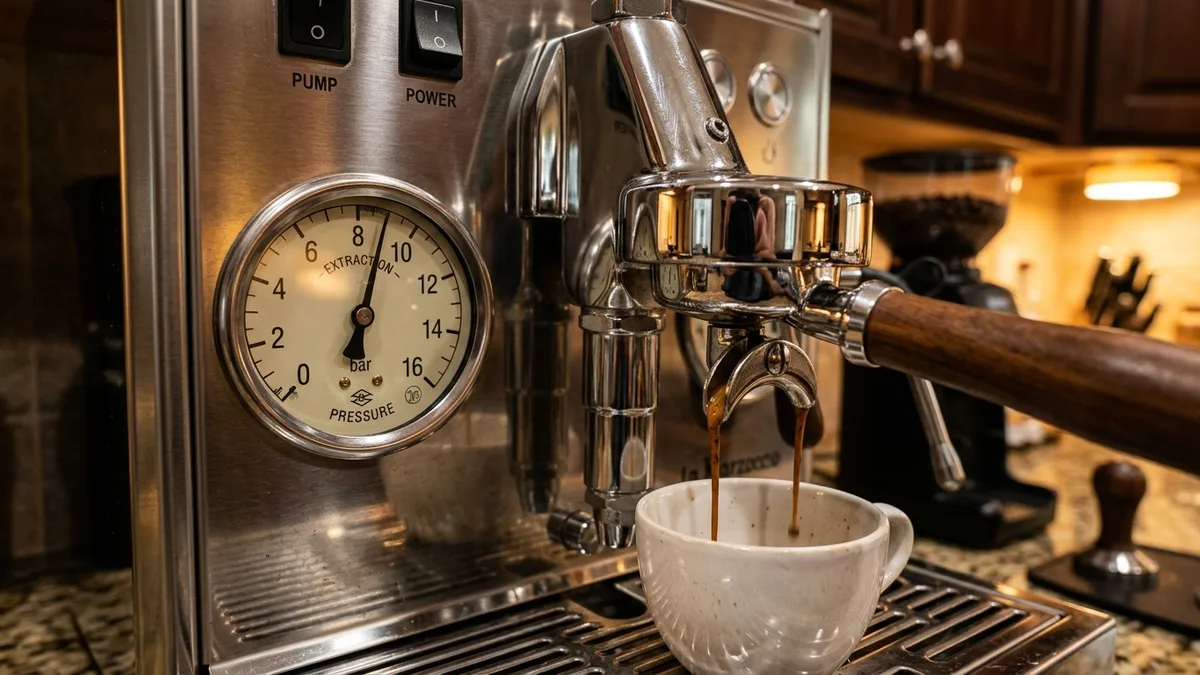
The Breville Barista Express (BES870XL) and Barista Touch are legendary for bringing cafe-quality espresso to the kitchen countertop. However, one of the most alarming sights for any owner is watching the front analog pressure gauge needle pin all the way to the far right—soaring past the grey ‘Espresso Range’ (8 to 11 bar) into the dangerous 14 to 15 bar zone. When pressure climbs this high, the vibration pump groans under extreme resistance, water sprays around the portafilter collar, and the resulting espresso drips out in black, tar-like drops that taste intensely bitter.
The gauge does not measure water pumped; it measures resistance created by your coffee puck. Over 80% of over-pressure cases are caused by a grind that is too fine, an overfilled basket, or using pressurized double-wall filters with fine espresso grounds.
How Breville’s OPV and Hydraulic Circuit Operates
Inside the Barista Express, a standard 15-bar Italian Ulka vibration pump pushes cold water through the ThermoCoil heating system into the 54mm group head. To prevent this 15-bar pump from crushing the coffee bed with excessive force, Breville installs an internal Over-Pressure Valve (OPV) calibrated to open between 13.5 and 14.5 bar on older models, and 9.5 to 11 bar on newer production units.
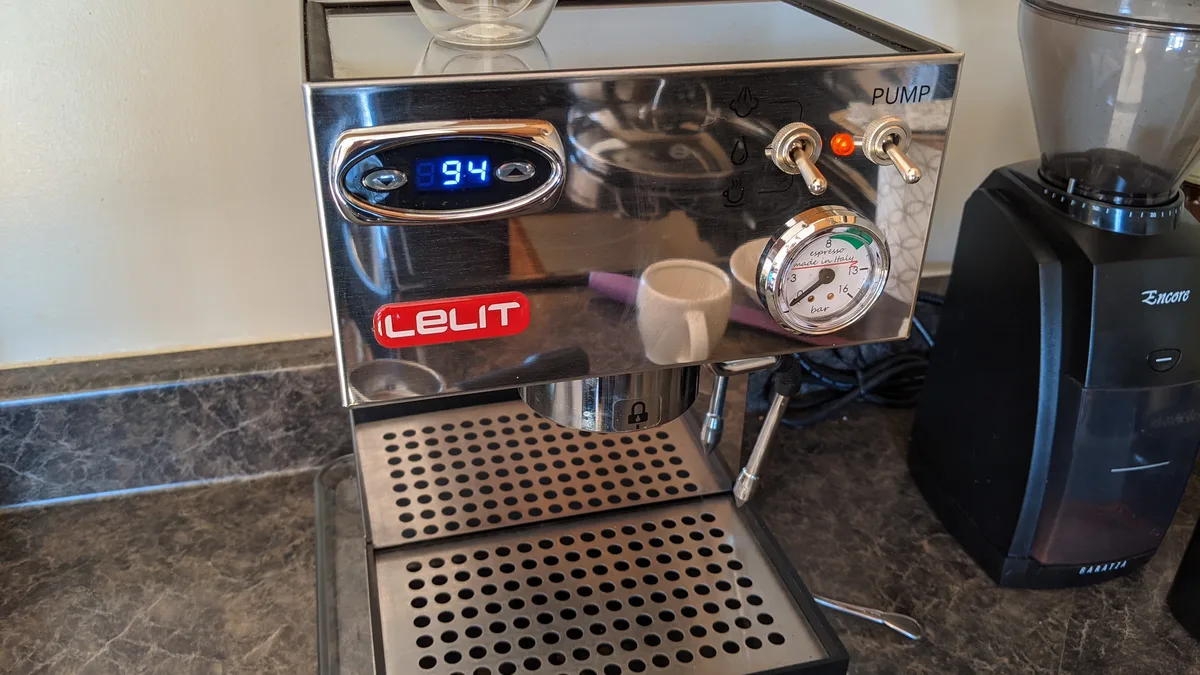
When the coffee bed creates hydraulic resistance exceeding the OPV’s spring tension, the valve opens, shunting excess hot water back into the drip tray. If the OPV fails closed, or if your coffee bed is compacted into an impermeable solid cake, the pump ramps up to its absolute physical maximum output (over 15 bar), forcing the needle off the scale.
Diagnostic Matrix: Over-Pressure Symptoms & Solutions
| Symptom | Hydraulic Cause | Check Method | Immediate Correction |
|---|---|---|---|
| Gauge Maxed Out (>14 Bar), Zero Espresso Flow | Puck choked by microscopic grinds | Water unable to permeate coffee bed | Adjust internal upper burr setting coarser |
| Pressure High with Pressurized Dual-Wall Basket | Dual-wall single pinhole choked with fines | Inspect bottom of basket with bright light | Switch to single-wall unpressurized basket |
| Shower Screen Imprint on Dry Puck Before Brew | Severe basket over-dosing (>19.5g) | Use Breville Razor tool to measure headroom | Reduce dose from 19g to 17.5g |
| Pressure Pins High Even on Blank Water Shot | Group head shower screen or brass dispersion block choked | Run shot without portafilter inserted | Unscrew Allen bolt and soak screen in Cafiza |
5 Step-by-Step Fixes to Tame Over-Pressure
1. Calibrate the Internal Top Burr Ring
The Barista Express features two grind adjustments: the external side wheel (1 to 30) and an internal adjustable top burr (1 to 10). If the internal burr is set to #1 or #2 from the factory, even coarse outer settings will choke the machine. Remove the hopper, unlock the wire handle, and set the internal burr to #4 or #5.
2. Down-Dose to the Standard 54mm Specification
Breville’s 54mm portafilter basket is deeper and narrower than commercial 58mm baskets. An 18.5g or 19g dose creates a thick bed that expands against the shower screen screw. Weigh exactly 17.0 to 17.5 grams on a digital scale to provide 2mm of headspace for even expansion.
3. Verify Single-Wall vs. Dual-Wall Baskets
If you are grinding fresh whole beans, you must use the Single Wall (non-pressurized) basket. The Dual Wall basket is designed exclusively for pre-ground store-bought coffee. Using fresh fine grinds in a dual-wall basket doubles hydraulic resistance, pinning the pressure gauge.
“High extraction pressure (>12 bar) causes the coffee bed to compress into an impenetrable puck, forcing water to carve violent side channels. Dialing in your Breville between 9 and 10 bar yields 30% higher sweetness and completely eliminates bitter astringency.” — Prosumer Barista Consultant
Official Manufacturer Documentation & Support
For factory-authorized schematic diagrams, replacement parts catalogs, and official warranty registration, consult the Breville Official Customer Support & Product Manuals.
Frequently Asked Questions (FAQ)
Can I adjust the OPV valve inside my Barista Express?
Older BES870XL models use an OPV with a threaded brass adjustment cap sealed with threadlocker. Many enthusiasts adjust the brass spring tensioner 1.5 turns counterclockwise to achieve a flat 9-bar extraction.
Why does my pressure gauge read zero on blank shots?
This is completely normal. Without a coffee puck or rubber blind backflush disc in the portafilter, water flows freely out the shower screen with zero resistance, keeping the gauge at zero.
Does tamping too hard cause over-pressure?
No. You cannot tamp ‘too hard’. Once all air is removed from between coffee particles (typically at 25-30 lbs of force), the puck cannot be compressed further. Excessive grind fineness is the real culprit.
Understanding Breville’s Factory Pressure Calibration (15 Bar vs. 9 Bar)
A common source of confusion among Barista Express (BES870XL) owners is why the pressure gauge needle often climbs into the upper 12 to 14 bar range even when the extraction appears acceptable. From the factory, earlier generations of the Barista Express were engineered with an internal Over-Pressure Valve (OPV) calibrated to roughly 13.5 to 14.0 bar.
Breville originally designed this high pressure ceiling to ensure dual-wall pressurized baskets could force pre-ground supermarket coffee through the single micro-hole to create artificial crema. However, for specialty whole-bean coffee in a single-wall unpressurized basket, 14 bar of pressure creates severe puck compaction. Water compresses the fine particles into an impermeable barrier, forcing high-velocity micro-channels along the basket edges.
The 4-Step Dial-in Protocol for Perfect 9-Bar Extraction
- Standardize the Dose: Use a digital scale accurate to 0.1g. Lock your dose at exactly 17.5 grams. Do not alter the dose while dialing in; adjust only the grind setting.
- Internal vs. External Burr Calibration: Set the internal top burr to setting #4. Start with the external grind size wheel at #8.
- Evaluate the Shot Timing: Press the 2-Cup button. From the moment the pump engages, pre-infusion should run for 8 to 10 seconds at low pressure (needle in the pre-infusion zone). High pressure should ramp up smoothly, with espresso dripping at 10 to 12 seconds and reaching 36 grams of liquid yield in 26 to 30 seconds.
- Reading the Gauge: During peak extraction, the needle should hover perfectly between 11 o’clock and 1 o’clock on the dial. If the needle pins past 2 o’clock, move the external wheel 2 steps coarser.
Cleaning the Brass Shower Dispersion Block
Behind the round wire mesh shower screen sits a brass dispersion block held by a central 4mm Allen bolt. Over months of brewing, fine coffee oils bake onto the four perimeter water outlets of this brass block. When these outlets become partially blocked, water enters the basket in concentrated jets rather than an even shower, creating artificial pressure spikes. Remove the Allen bolt, drop the brass dispersion disc into a cup of hot water with Cafiza for 20 minutes, and reassemble with moderate hand torque.